

Passkeys, Biometrics & the Future of Authentication: Are Passwords Dead?
 Pete
Pete
- November 12, 2025 , Pete
- Password & security
In today’s digital-age, the future of authentication is moving fast. With growing threats, increased online identity use, and the explosion of connected devices, the humble password is increasingly under pressure. So the question on many minds: are passwords dead? The quick answer is: not yet — but things are evolving.
Enter passkeys authentication and biometric authentication, both of which promise to reshape how we log in, how we stay secure, and how we think about identity. Whether you’re a regular user or an IT professional, this is a turning point: a moment to see what’s coming next and what it means for you.
What Are Passkeys and How Do They Work?
“Passwordless login,” you may have heard, is the buzzword. But what it really means in practice is often better explained by the term passkeys authentication — a modern sign-in method built on the open standards of the FIDO Alliance and WebAuthn.
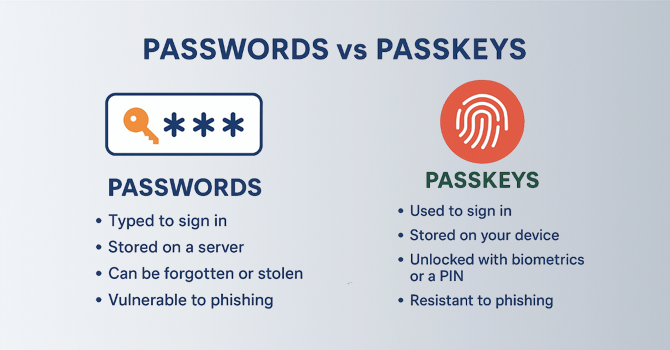
In simple terms: rather than typing a password that’s stored on a server somewhere (and vulnerable to reuse, theft, or phishing), a passkey uses a cryptographic key pair. One part (the private key) lives securely on your device; the other part (the public key) is stored by the website or service. When you sign in, your device uses the private key — often unlocked with your fingerprint, face, or device PIN — to prove who you are. The result? A login that’s both more secure and simpler for the user.
How It Feels for the User
If you use a password manager that supports passkeys, the experience feels very familiar. When you create or register a passkey, the app stores the private key in your encrypted vault and syncs it across your trusted devices. The next time you visit that website, it can present your passkey automatically — no typing, no remembering, and no chance of phishing.
Without a password manager, your passkeys are usually stored locally by your operating system or browser, such as iCloud Keychain on Apple devices or Google Password Manager on Android and Chrome. That setup works fine if you stay within one ecosystem, but it can get tricky when you switch devices, use different browsers, or need to recover access after losing your phone. In other words, passkeys are easiest to use when managed by a cross-platform password manager that keeps everything secure, synchronized, and accessible wherever you log in.
Key benefits of passkeys:
- Phishing-resistant: There’s no password to steal or trick you into entering.
- Faster and easier: No need to remember or type complex strings.
- Standards-based and interoperable: Built on FIDO2/WebAuthn, so they work across major browsers and operating systems.
According to the FIDO Alliance, the number of online accounts that can now use passkeys is growing rapidly — double the number just a year earlier. That said, only about 20% of the world’s top 100 websites had full passkey support as of 2024, according to the FIDO Alliance report.
So while passkeys are increasingly ready for prime time, the reality is simple: we’re still living in a password-world, and passwords will continue playing a vital role for the foreseeable future.
Biometrics and the Rise of Password-Free Access
Hand in hand with passkeys is biometric authentication, such as fingerprint scans, face recognition, iris scans, voice prints and more. For many users, biometrics feel intuitive: you simply are the login credential.
Biometric methods are a strong complement to passkey authentication. Here’s why:
- They unlock the device or passkey smoothly (no PIN or password).
- They strengthen the “you are you” element of authentication, bringing physical presence into the loop.
- For many services, combining biometrics + passkeys gives a seamless, password-free experience.
However, there are still plenty of considerations:
- Privacy concerns: What happens to my biometric data? Is it stored locally or in the cloud? Can it be mis-used?
- Device dependency: If you lose the device with the biometric sensor, how do you recover?
- Adoption and compatibility: Not all services or devices support all biometric methods yet.
In short: biometrics bring convenience and a strong sense of “me logging in,” but they don’t magically replace the broader authentication ecosystem. Instead, they augment it — much like passkeys do.
Are Passwords Really Dead — or Just Evolving?
You’ve probably seen headlines proclaiming “The password is dead.” But here’s our twist: “The password is dead, long live the password.” What we mean is that passwords aren’t going away tomorrow, but their role is changing. They’re evolving into one part of a richer authentication landscape — not the sole pillar.
Here’s how we see things:
- Many websites still rely heavily on passwords today for login, account creation, device recovery, backup options or first-time sign-in.
- Passkeys and biometrics are growing fast, but they haven’t yet covered the full spectrum of services, devices and user scenarios.
- A strong authentication strategy now means supporting hybrid authentication: integrating passwords, passkeys and biometrics together.
- For users and businesses, that means a password manager in a passkey world becomes critical: you’ll still have passwords, you’ll add passkeys, and you’ll need a system that handles both gracefully.
According to a recent Cybernews study, more than 19 billion passwords have been leaked online, and an astonishing 94% of them were either weak or reused. Despite growing awareness of password risks, these numbers show that traditional logins still dominate our digital lives.
What the Future of Authentication Means for Users and Businesses
For both individuals and organisations, the shift toward next-generation authentication means real opportunity, but also real choices.
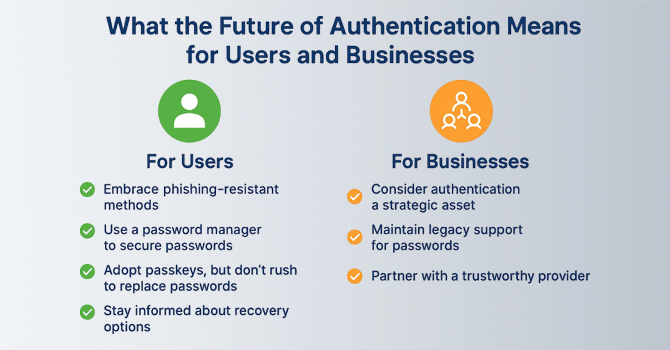
For Users
- Embrace methods that are phishing-resistant authentication methods (passkeys + biometrics) — these give you stronger protection and less friction.
- Use your password manager today (like Sticky Password) to secure existing passwords, because even as passkeys expand, passwords will remain relevant for the foreseeable future.
- When services offer passkeys, adopt them, but don’t rush replacing all your passwords today.
- Stay informed about recovery options and device transitions — if you switch or lose a device, you’ll want robust backup.
For Businesses
- Consider authentication a strategic asset: stronger login = better user experience = less friction = lower support costs.
- Maintain legacy support: even as you introduce passkeys and biometrics, keep passwords as a fallback — and ensure your systems (vaults, backup, account recovery) support mixed methods.
- Partner with a trustworthy solution provider that supports both passwords and the emerging authentication ecosystem — enabling you to future-proof your identity platform.
Why Sticky Password’s Approach Matters
At Sticky Password, we believe in innovation that feels familiar. We’re not rushing to abandon passwords — because you may need them, and many services still depend on them. But we’re also excited about what passkeys and biometrics bring. Our password manager is evolving to support passkeys and provide a unified experience where you manage your credentials (old and new) in one place.
We see the landscape as richer. A world where you use a passkey for your banking login, a fingerprint for your personal account, and a password for a legacy service — all managed and secured in one simple vault.
Final Thoughts
So, are passwords dead? In short, no. As we move deeper into the era of passkeys authentication and biometric authentication, we’re entering a time when secure login experience means less typing, more verifying, and fewer problems with compromised credentials. For users and businesses alike, the future of authentication is about moving beyond “just a password” to a more intelligent, flexible and secure ecosystem.
What authentication method do you use? Are you ready to adopt passkeys — or are you sticking with passwords for now? We’d love to hear your thoughts in the comments below.